Velocity Time Integral
By erich | Last updated: May 02, 2026
Velocity Time Integral (VTI) is used to assess cardiac output and fluid responsiveness. It is the distance blood travels through an orifice in one heartbeat.
Uses
- Fluid Responsiveness: Serial VTI measurements help determine if a patient will increase their cardiac output with a fluid bolus (e.g., assessing before/after a passive leg raise).
- Cardiac Output Estimation: VTI is used to calculate stroke volume (SV) and cardiac output (CO)
- Risk Stratification: Low VTI values can indicate cardiogenic or hypovolemic shock.
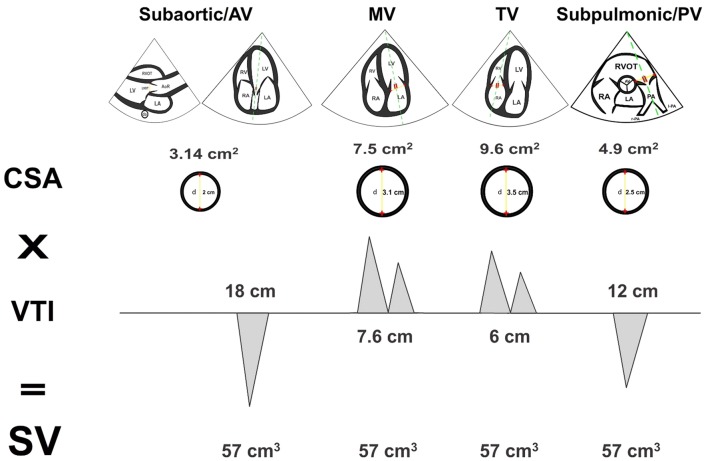
How to Measure LVOT VTI
- Obtain View: Utilize the apical 5-chamber view to visualize the LVOT. Position Gate: Place the pulse wave (PW) Doppler sample gate within the LVOT, just proximal to the aortic valve.
- Activate Doppler: Activate pulse wave Doppler to obtain the spectral tracing.
- Trace Waveform: Trace the outline of the systolic waveform to allow the machine to calculate the VTI.
- Measure LVOT Diameter: Measure the internal diameter of the LVOT in the parasternal long-axis view to calculate the area.
Limitations
The LVOT VTI is not reliable for estimating the SV/CO in:
- moderate-to-severe aortic regurgitation (AR)
- subaortic obstruction (LVOTO, fixed and/or dynamic), eg in extreme hypovolemia, asymmetric left ventricular septal hypertrophy (specially at a low preload and high inotropic stimulation), anterior myocardial infarctions with compensatory hyperdynamic basal segments of the interventricular septum and in Takotsubo syndrome.
Dynamic LVOTO and AR produce high LVOT velocities/VTI and thus overestimated VTIs. In serial measurement changes maybe due to increased SV or from an increased regurgitant volume (AR) or subaortic obstruction (LVOTO).
Normal Values and Tips
- Normal VTI: A common rule of thumb is that a normal LVOT VTI is around 20 cm.
- "Fluid Responsive" Increase: Generally, an increase in VTI by more than 10-12% after a passive leg raise suggests fluid responsiveness.
- Ensure the Doppler beam is as parallel to the flow as possible to avoid underestimating the velocity.
Serial assessment of the SV and CO can be done measuring the VTI (LVOT, MV or RVOT) and calculating the minute distance, without the need to know the cross-sectional area (CSA). Changes in the VTI correlates with SV and minute distance reflects reflects CO.
Comments
Make a CommentNo comments yet. Be the first to comment!